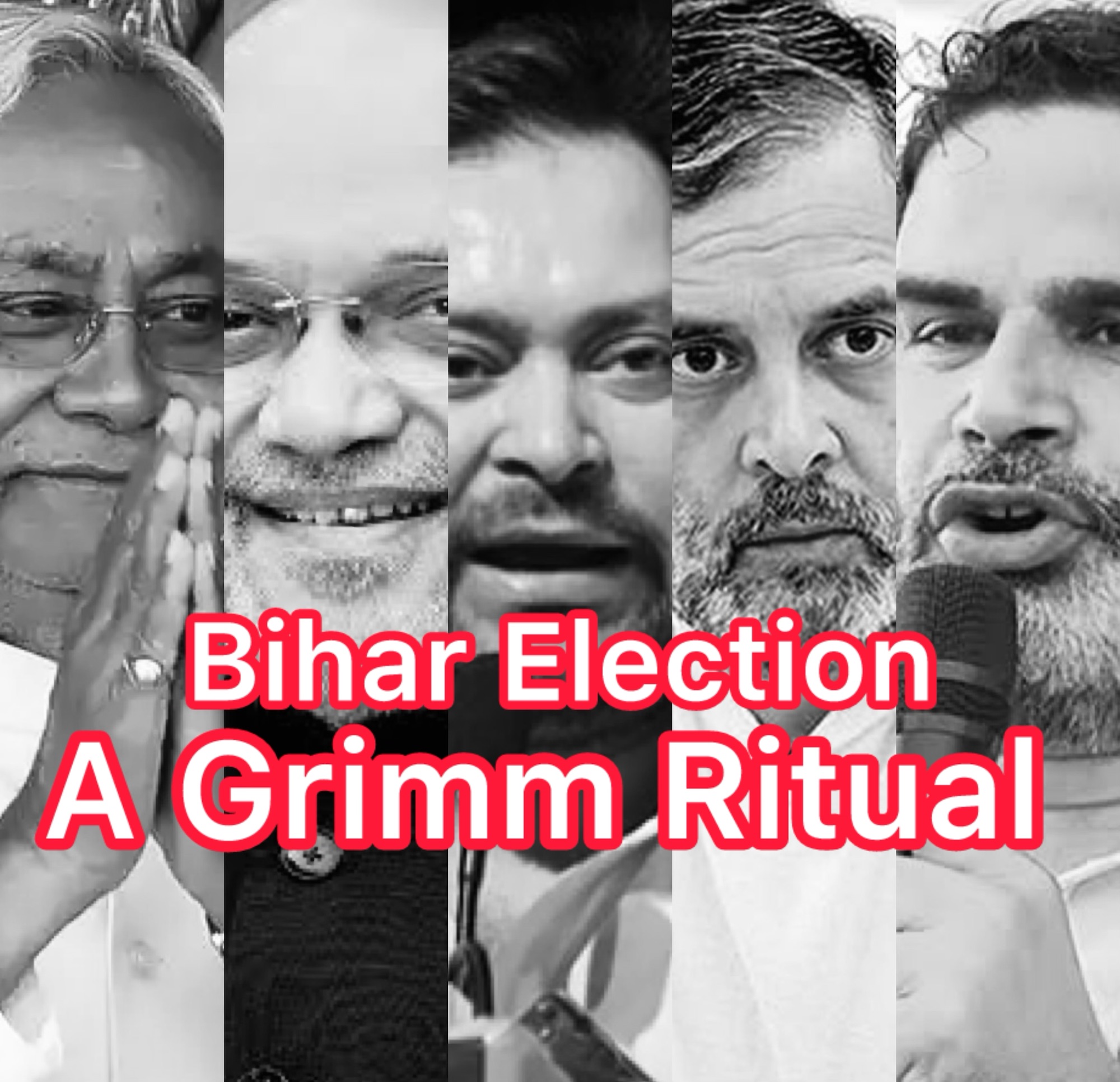
In most democracies, elections are a moment of renewal of hope for the future. But for voters of Bihar, elections have long been a grim ritual, not of choosing the best, but of settling for the least damaging. It is a tragedy of democracy where the voter’s dilemma boils down to a situation of choice akin to trusting either thugs or dacoits.
The choices may change in name, alliance, or symbol but the underlying options have too often been the same, a mafia-backed populist in one corner, and a power-hungry pragmatist in the other.
The ‘Social Justice’ Mirage:
The rise of the Rashtriya Janata Dal (RJD) in the 1990s was painted as a revolution, a so called backward caste assertion against entrenched upper-caste dominance. It promised social justice, empowerment of the marginalized, and a new dawn for Bihar’s ignored millions. But what unfolded instead was a brutal descent into lawlessness. Under Lalu Prasad Yadav and later Rabri Devi, social justice became a facade for jungle raj, a state ruled not by law, but by criminals with political patronage.
Kidnappings became a parallel industry. Universities and hospitals turned into ghost institutions. Honest officers were humiliated, and the police became puppets.
For a generation, progressive governance was replaced by populist sloganeering and public faith was replaced with fear. The poor didn’t feel empowered, they simply had a different master with much worse whip.
The NDA Alternative: Stability Without Soul
After fifteen years of RJD rule, Bihar turned to Nitish Kumar and the BJP-led NDA with hope that law and order would be restored, that roads, schools, and health centres would reappear, and that governance would no longer be a favour but a right. To some extent, Nitish Kumar delivered. Roads were built. Kidnappings dropped. There was a visible shift in bureaucratic discipline and urban order, especially in the first decade of his rule.
But that too came with caveats, governance became mechanical, unemployment induced migration continued unabated, education system marred with exam paper leaks.
More troublingly, Nitish’s moral credibility took a hit with his constant alliance flip-flops. From partnering with BJP to calling it communal, then rejoining again, and now shifting back, his politics seem more about self-preservation than public service.
So where does this leave the common Bihari voter? It’s a painful irony Bihar, the land of Chanakya, Buddha, Mahavir and Ashoka, of JP and Dr. Rajendra Prasad, now finds itself stuck in a democracy without dignity and leadership without vision. Flight of talent from Bihar’s soil shall prevail. The educated leave, the poor suffer, and the middle class suffocates in silence.


