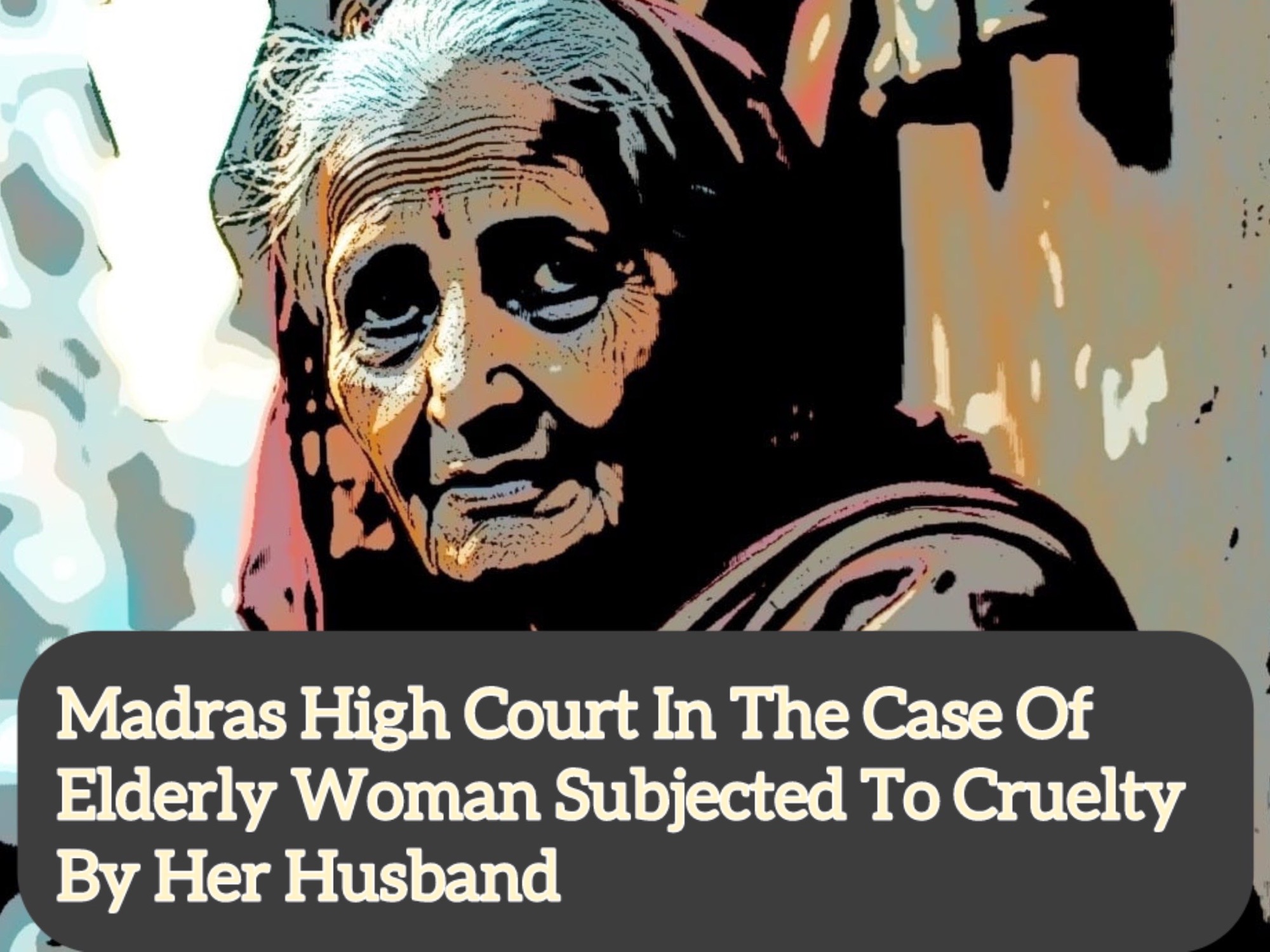
The Madras High Court has reaffirmed that advanced age cannot be used as a shield to justify cruelty within marriage, while restoring the conviction of an elderly man for subjecting his wife to sustained mental and economic abuse (Indira v. Danaseelan Mudaliyar, CRL A(MD) No. 17 of 2018)
The case traces back to a marriage solemnised in 1965 between Indira and Dhanaseelan Mudaliyar. Over the years, the relationship deteriorated, with the wife alleging continuous acts of cruelty, including denial of food, social isolation, restriction on communication, and economic deprivation. These acts, she contended, caused severe mental trauma and forced her to live in indignity.
In 2016, a trial court found the husband guilty under Section 498A of the Indian Penal Code, holding that the evidence established cruelty towards the wife. He was sentenced to six months’ simple imprisonment and fined ₹5,000. The trial court also took note of the wife’s vulnerable condition and the prolonged nature of the abuse.
However, in 2017, a sessions court overturned the conviction and acquitted the husband, reasoning that the wife’s testimony was not sufficiently corroborated by independent witnesses. This acquittal prompted the wife to challenge the appellate court’s decision before the Madras High Court.
On October 31, 2025, the Madurai Bench of the Madras High Court, presided over by Justice L Victoria Gowri, allowed the wife’s appeal. The High Court set aside the acquittal, terming it a misdirection in law, and restored the trial court’s conviction and sentence. The court observed that domestic cruelty often occurs within the confines of the home, making independent eyewitness testimony rare. It held that credible testimony of the victim, supported by surrounding circumstances, was sufficient to sustain a conviction.
The High Court further emphasised that cruelty is not limited to physical violence and that persistent mental harassment, social isolation, denial of basic necessities, and economic control amount to grave cruelty under the law. The court categorically ruled that old age does not sanctify cruelty and cannot be invoked as a mitigating factor to erase sustained abusive conduct.
In addition to restoring the criminal conviction, the High Court upheld the maintenance awarded to the wife under the Protection of Women from Domestic Violence Act, including a monthly maintenance of ₹20,000. The court underlined the obligation of spouses to ensure dignity, security, and emotional well-being within marriage, regardless of age or duration of the relationship.
The judgment, reported on November 4, 2025, reinforces the principle that marriage does not confer a licence to inflict suffering and that the law must protect victims of domestic abuse, including elderly women who often endure cruelty in silence for decades.

 Vidhik-Vishleshan (Decoding The Law & More)