
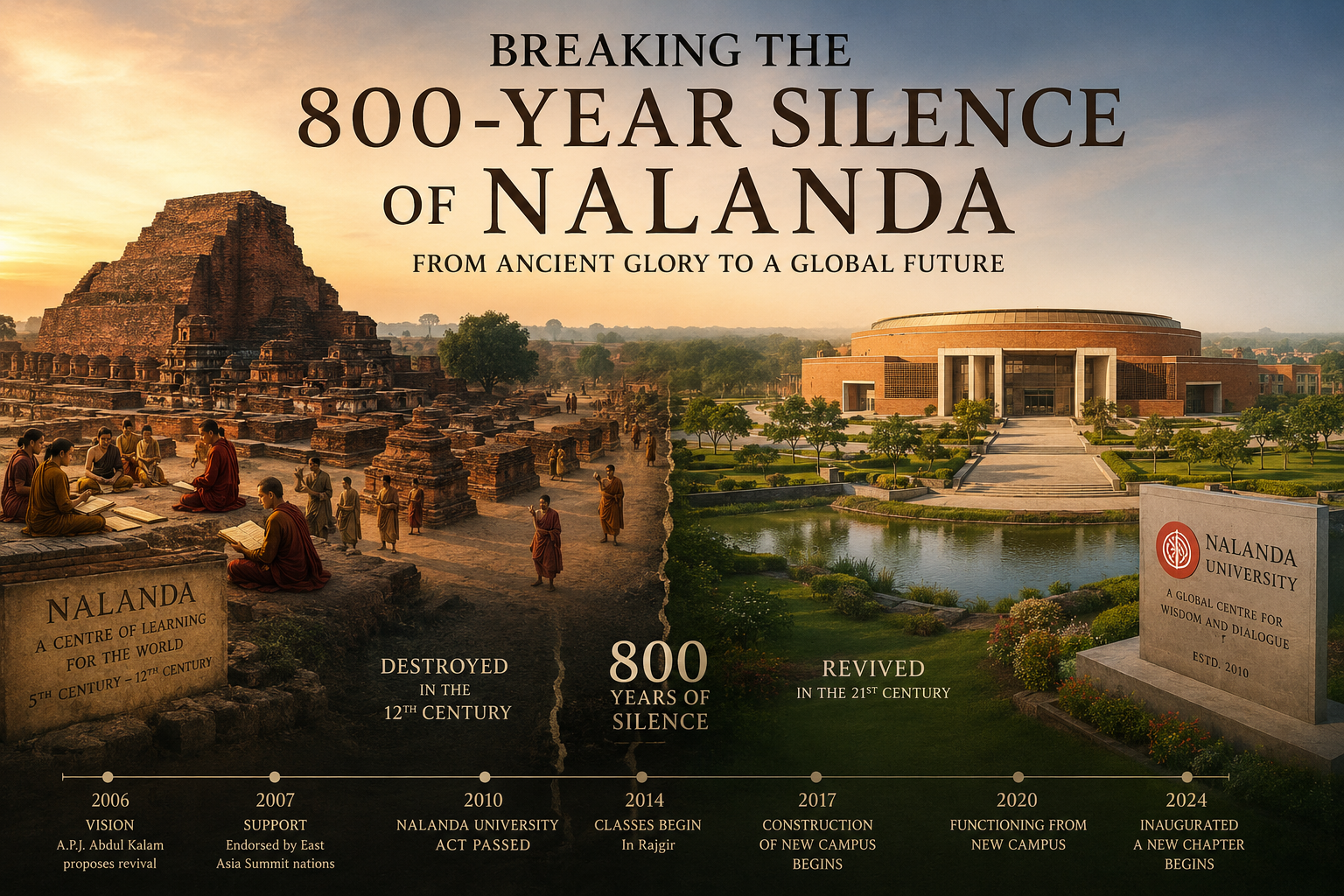
In 2006, when former President A. P. J. Abdul Kalam proposed reviving Nalanda during an address to the Bihar Legislative Assembly. What began as a visionary idea soon transformed into an international project supported by East Asia Summit nations. Countries across Asia recognised that Nalanda was never merely India’s heritage. It was part of a shared Asian intellectual civilisation.
Long before Europe built Oxford or Cambridge, before modern nations spoke of “global universities,” there stood in ancient India an institution so extraordinary that scholars travelled thousands of kilometres across mountains, deserts, and kingdoms simply to study there.
Nalanda was not merely a university. It was the intellectual heartbeat of Asia.
Founded over 1,500 years ago in present-day Bihar, Nalanda attracted students and scholars from China, Korea, Tibet, Japan, Indonesia, Persia, and beyond. Thousands studied philosophy, astronomy, medicine, mathematics, logic, grammar, politics, and Buddhist thought within its vast monastic-academic complex. Its libraries were legendary. Ancient accounts describe towering repositories of manuscripts so immense that when invaders destroyed Nalanda in the 12th century, the fires reportedly burned for months.
And then came silence.For nearly 800 years, one of the greatest centres of learning the world had ever seen survived only in ruins, memory, and historical texts.
But history has an unusual way of returning. Post 2006 the revival gradually took institutional shape. The Indian Parliament passed the Nalanda University Act in 2010, granting the new university the status of an Institute of National Importance. In 2014, classes began from a temporary campus in Rajgir with a small batch of students. In 2016, the ancient ruins of Nalanda Mahavihara received UNESCO World Heritage recognition, reconnecting the modern revival with the global prestige of the ancient institution.
Then came the physical rebirth. Spread across hundreds of acres near the ancient ruins, the new campus of Nalanda emerged not as a symbolic reconstruction of the past, but as a modern international university designed for the future. Built as a net-zero green campus with solar infrastructure, water conservation systems, and sustainable architecture, it represents an attempt to merge ancient intellectual heritage with contemporary global priorities.
In June 2024, Prime Minister Narendra Modi formally inaugurated the new campus at Rajgir. That moment carried significance far beyond the opening of another educational institution.
For centuries, India’s civilisational discussions have often revolved around what was lost, destroyed, colonised, or forgotten. Nalanda’s revival changes the direction of that conversation. It is one of the rare modern projects attempting not merely to preserve heritage, but to restore intellectual continuity.
The importance of Nalanda today is therefore not limited to academics alone. It reflects India’s growing effort to reclaim civilisational confidence through knowledge rather than symbolism alone. It also demonstrates how education can become an instrument of diplomacy and cultural influence. The participation of multiple Asian countries in the university’s revival shows that Nalanda still possesses something powerful enough to transcend borders, the memory of a shared intellectual world once connected through learning instead of conflict.
The ancient Nalanda once drew seekers from across continents. The modern Nalanda now attempts something equally ambitious, rebuilding an institution where ideas, cultures, philosophy, ecology, and international cooperation can once again meet on Indian soil.
After 800 years of silence, Nalanda is speaking again.


