What happens when a state says no to alcohol completely?
A noble step indeed, but too costly for an already financially struggling state.In addition this ‘dry’ decision led to overflowing jails, black markets, hooch deaths, and heavy losses in revenue.
Story of Bihar’s prohibition – where good intentions met some very hard realities.
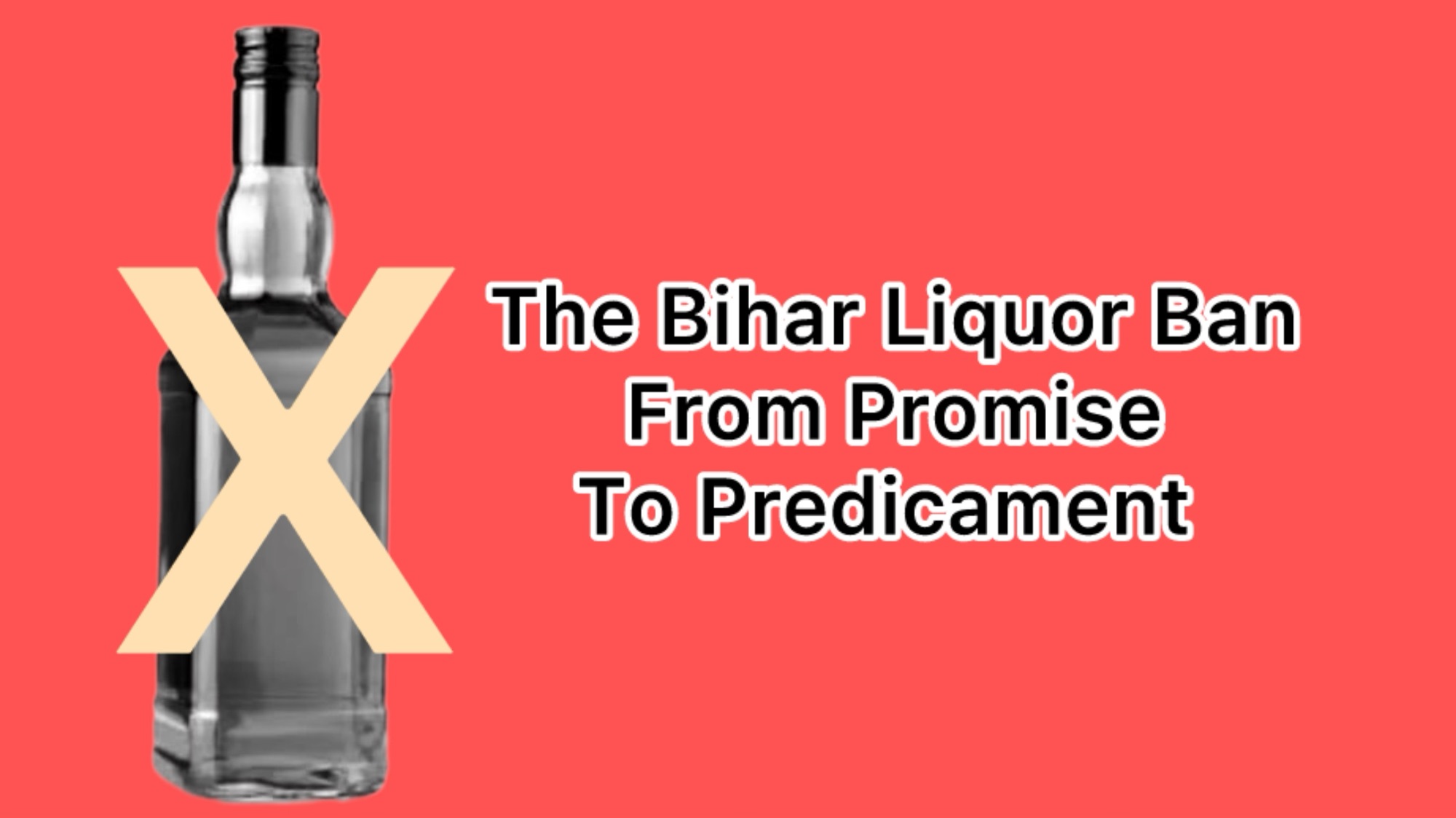
Back In 2016, Bihar, one of India’s financially struggling states attempted to emulate Gujarat by imposing a blanket liquor prohibition through the Bihar Prohibition and Excise Act 2016. This move was framed as a much needed bold social reform which aimed at curbing alcohol-induced domestic violence, improving public health, and promoting social justice, particularly for women and marginalised communities.
Rooted in Article 47 of the Constitution, the ban was projected as a moral commitment to welfare over revenue earnings by State. However, by 2025, this experiment has left a complex legacy. While some gains in household savings and social awareness were surely reported, the unintended consequences have significantly reshaped Bihar’s economic and legal landscape, ranging from a ₹4 to ₹5,000 crore annual revenue loss as per news reports , to a ballooning underground liquor market, to mass criminalisation of the poor and overburdening of courts and prisons..
So is Bihar’s liquor law a moral triumph? Or a mishandled situation spiraling out of control? According to the CAG, Bihar lost an estimated ₹1,490 crore in 2016–17 alone due to the prohibition, with excise enforcement costs nearly doubling from ₹49.6 crore to ₹92 crore
The Big Ban – Why It All Began
2015 saw Bihar’s Chief Minister Nitish Kumar promising a liquor ban and his winning. But this wasn’t just politics. Women across the state, tired of drunk violence, and poverty had been demanding this for years. So, in April 2016, Bihar enforced one of the harshest liquor bans in India through the Bihar Prohibition and Excise Act.
What the Law Actually Said
In 2016 this wasn’t a soft ban. It criminalised everything, drinking, selling, storing, transporting, even possessing alcohol.
Section 30: Up to life imprisonment.
Section 37: Up to 5 years for drinking. Your house could be sealed. Your car confiscated. Families arrested.
Who Enforced It?
The state handed the reins to the Excise Department, police, and district magistrates. Special courts were set up to fast-track cases. But what followed was a tsunami. Over 3 lakh people were booked under the law in just three years and most of them from poor and marginalised communities. Jails were bursting. Courts were clogged. People were arrested for rituals, for birthday parties, for having sealed bottles in cars. The judiciary was overwhelmed. The real criminals? their cases got delayed because the system was busy chasing beer bottles.
The High Cost of Going Dry
Before the ban, Bihar earned over ₹5,000 crore annually through liquor taxes. After 2016? zero. Meanwhile, neighbouring states like Jharkhand and West Bengal saw liquor sales skyrocket. Why?
Smugglers were thriving at Bihar’s borders. Bihar’s economy was bleeding and drinking continued. As per news reports the excise revenue in 2015–16 was around ₹4,000 crore, after the ban, Bihar’s treasury lost approximately ₹40,000 crore in expected earnings over seven years.
Meanwhile neighbouring states saw spikes in revenue. West Bengal and Jharkhand benefited from siphoned-off liquor sales, Bihar’s ban fueling black-market growth.
Amendments – Fixing the Fallout
The 2016 Law was too harsh, by 2018, it was clear things weren’t working. The government tweaked the law, clarified definitions, shifted the burden of proof. But the real change came in 2022.
A glance at law:
The 2016 Law brought in total prohibition on manufacture, sale, purchase, consumption, possession and transport of all forms of liquor and intoxicants. The 2022 amendment retained prohibition but allowed relief for first-time and petty offenders under Section 37. 2022 amendment permitted compounding of first-time consumption offence.
Authority for Enforcement as per 2016 Act are Excise Commissioner, Excise Officers, Police Officers, Special Courts. In 2022 Executive Magistrates empowered for compounding and summary disposal.
Punishment for consumption of liquor as per 2016 Act is upto 5 years imprisonment plus fines. In 2022amendment Compounding has been permitted on payment of fine.
For manufacture/sale/transport/storage, as per 2016 Act, 10 years to life imprisonment plus fine up to ₹10 lakh. 2022 saw no change. Summary disposal for minor contraventions.
So Now, if you were caught drinking for the first time, you could just pay a fine. No jail. Executive Magistrates could settle cases.
The Dark Side – Hooch Tragedies
But while the law softened, something darker brewed underground. Hooch, cheap, poisonous liquor took over. Saran, Gopalganj, Nawada, Bhagalpur, all reported deaths. Banning liquor didn’t stop drinking. It just made it deadly. Police reported 199 official hooch deaths from 2016–2023; in 2022 alone, 114 deaths including 42 in the Saran incident in December triggered an NHRC finding of 77 deaths.
Gujarat liquor ban – why Gujarat didn’t collapse like Bihar
You might ask Gujarat also has prohibition. Why don’t they have this chaos? Simple. Gujarat has structure. There are permits for tourists, exceptions and industrial alcohol is tightly regulated. Bihar banned everything, but built no safety net. That’s the difference. Bihar witnessed rise of the black market. With legal liquor gone, illegal liquor flooded in. Smugglers took over. Thousands of crores flowed into the black market. Politicians? Many looked the other way. The state lost revenue. The underworld gained. It’s prohibition on paper but alcohol on demand, at a price.
Even the courts had had enough. The Patna High Court slammed the misuse of the law. The Supreme Court in 2022 said the judiciary was choking under liquor cases. They asked Bihar to rethink its policy.
In October 2022, the Patna High Court sharply criticised the government, stating prohibition had failed to implement, caused mafia proliferation, overburdened courts with liquor-related cases, and harmed poor communities.”
So where are we now? Bihar’s prohibition law is still in force but the ground reality is a mess. Police are exhausted. Courts are overwhelmed. The poor are punished, the rich are untouched, and alcohol? Still flowing. Just more dangerous and more expensive. Prohibition started with good intentions. But it’s become a tangled web of enforcement chaos, economic loss, and human tragedy.


